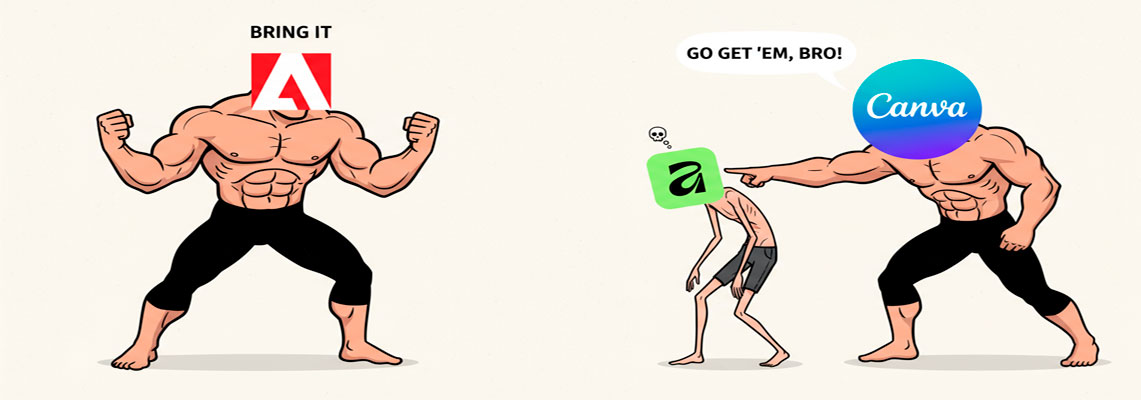

The illustration above, depicting a showdown between creative software giants, is perhaps a slight exaggeration (lol). But it does capture the very real tension in the design market today. It is an undeniable fact that Canva has been effectively chipping away at Adobe's long-held monopoly.
To me, the greatest evidence of this is Adobe Express. I firmly believe that if Canva had not successfully captured the market for quick, accessible design, Adobe Express would simply not exist. It was a direct market response.
Historically, however, Canva always had a "glass ceiling" or an "Achilles' heel." This was its limitation in vector refinement and, perhaps more significantly, professional editorial treatment. Typesetting a book or a complex magazine in Canva was not (until now) feasible. Essential features like paragraph styles, master pages, and other resources critical for professional layout were absent.
Now, the game is changing.
Less than a week ago, Canva announced its new push with the Affinity suite—a proposal to merge high-end vector, bitmap (photo), and publishing software into a single, cohesive environment. The challenge is as disruptive as it is ambitious. I recorded a video detailing my first impressions of this new software and its potential.
The controversy, however, extends beyond the software itself and strikes at the heart of the business model.
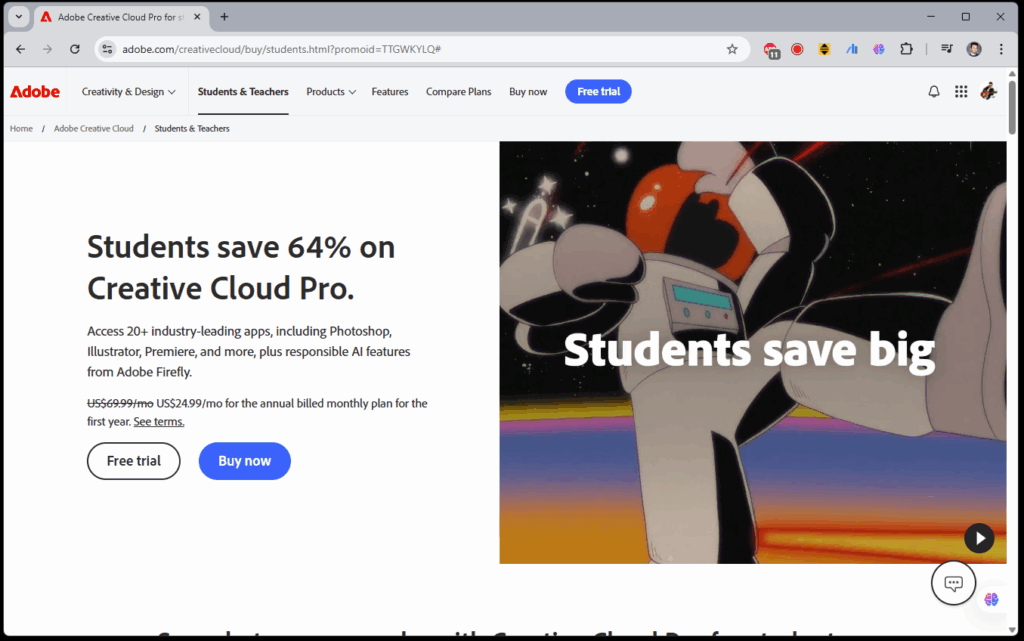
For many, Adobe's subscription-only model feels like a form of market abuse. I understand that in many countries, $25/month might seem trivial for a professional tool. However, when we translate this reality to countries like Brazil (from where I write this post), the situation is vastly different. The same value, converted to Brazilian Reais, represents a far more considerable—and burdensome—cost.
And to be clear, that $25 figure I'm citing is the discounted rate for students and teachers, which is my own case.
Will the Affinity suite usurp Adobe's dominance? I don't know. I believe it still has a long way to go, especially against a behemoth like Adobe Photoshop and the sheer inertia of users who (understandably) dislike migrating their workflows.
But as a Brazilian who feels the financial weight of that subscription every month, I am entirely open to the change.
As I mentioned in my video, if Canva were to launch a new, integrated tool that takes on Adobe Premiere, After Effects, and perhaps even an animation tool like Character Animator... imagine! A single, integrated suite with the Canva license model? It sounds like madness. But then again, the idea that Canva would acquire and integrate a full professional suite like Affinity also seemed implausible just a short time ago.
It leaves us with a reflection.
Are Adobe's stocks falling? We'll have to wait for the next chapter in this developing story.