
30 Minutes to Edinburgh: My First International Presentation and the "Home-Office" Paradox
They say a PhD journey is a marathon, but my first international conference felt like a 100-meter sprint — with a 30-minute warning.
I’ve spent the last year diving deep into how scientific knowledge moves from the "stickiness" of old repositories to the "spreadability" of digital networks. My research, co-authored with Professor Brasilina Passarelli, focuses on the SciELO Brazil YouTube channel and the emergence of video abstracts as a tool for Open Science. We analyzed over 700 videos to understand how science is becoming more multimodal and accessible.
But yesterday, the "theory of communication" met the "chaos of reality."
The Adrenaline of the Global South Being a researcher in Brazil involves navigating structural hurdles. While the iConference 2026 was happening in beautiful Edinburgh, Scotland, I was in Osasco, São Paulo. The financial gap between resources and the costs of international travel is a chasm many of us know too well. Even a registration fee represents a significant investment for a working-class scholar.
30 Minutes to Showtime Due to personal emergencies, my advisor couldn't join the session. I was ready to call it a day until — 30 minutes before the panel — the link finally landed in my inbox. It was "go time."
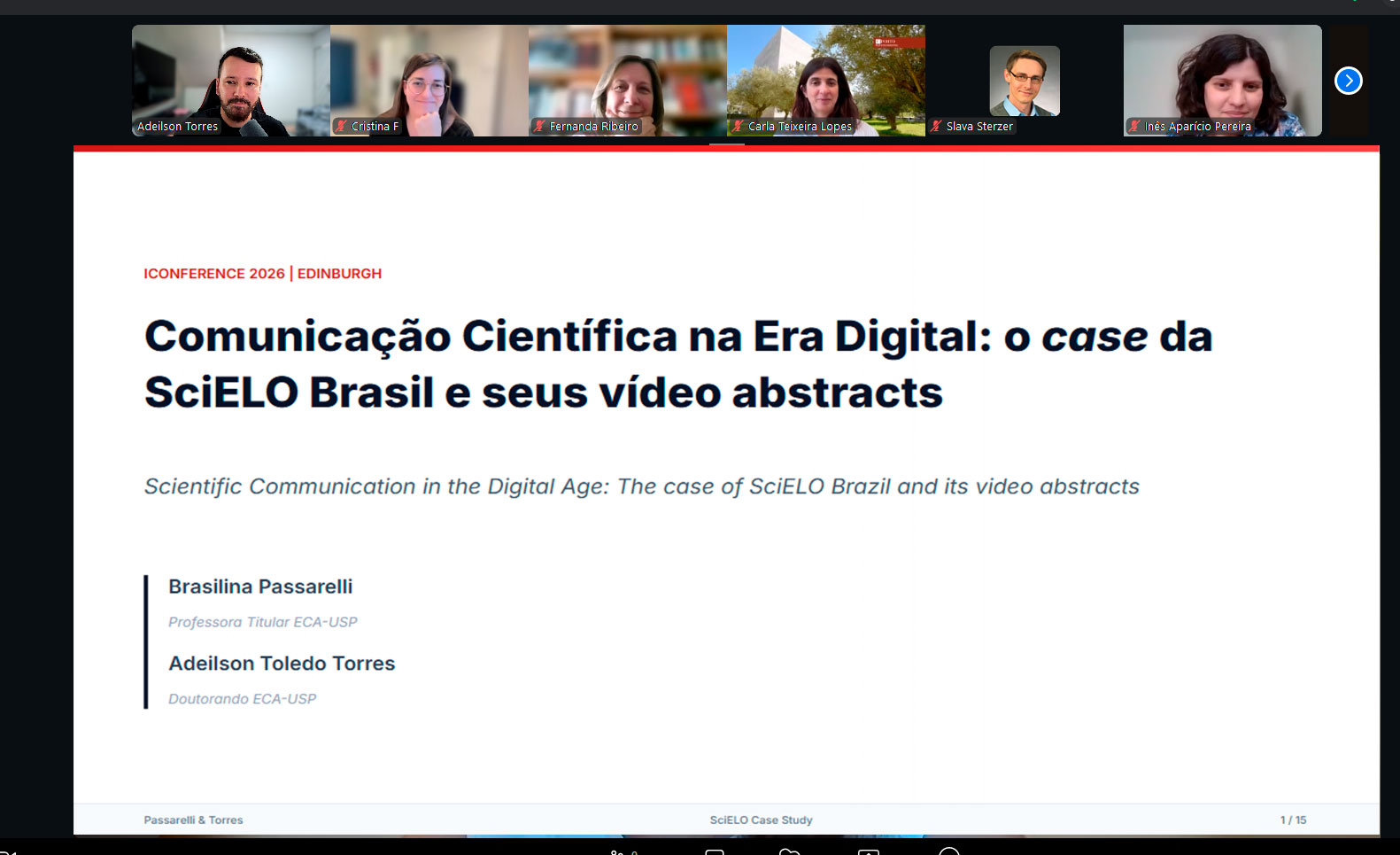
I decided to lean into the very medium I study: video. I presented our paper, "Scientific communication in the digital age: the case of SciELO Brazil and its video abstracts", using a pre-recorded video with Spanish subtitles to ensure our findings on scientific circulation reached the diverse, high-level audience in the room.
The Unexpected Guest Mid-presentation, as I was discussing the nuances of how algorithms shape scientific relevance, my youngest daughter burst into the room in tears. It was the ultimate "home-office" paradox. There I was, discussing the "second wave of information" with international peers, while simultaneously managing the very human, "first wave" needs of a crying toddler.
The Verdict Did I feel "dragged out" compared to the previous speaker? Maybe. But the interaction that followed was invaluable. My paper was approved among many talented peers, proving that our research at ECA-USP is on the right track.
This first step into the international arena wasn't perfect, but it was authentic. It reminded me that science isn't just about data points; it's about the persistence of researchers who, despite the distance and the "parenting cameos," continue to push for a more open and connected world.
Edinburgh, I'll see you in person next time. For now, the screen will do.