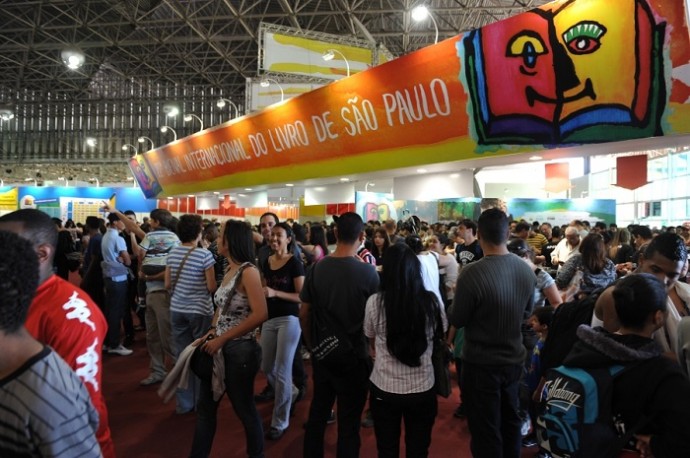

In 2014, I had the privilege of serving as a UX Consultant for one of Brazil's largest and most complex cultural events: the 23rd São Paulo International Book Biennial. The project was commissioned by the Brazilian Book Chamber (CBL), the event's organizer, with the Novari team leading the initiative.
This was a UX challenge of immense scale. The 2014 Biennial brought together 720,000 people over 10 days in a single, massive pavilion. Our goal was to map the complete, holistic user journey of this "analog" mega-event.
UX Is Not Just Digital, It's Human
While User Experience (UX) as a formal discipline began in technology, its principles are universal. It is the study of how a human being interacts with a system—whether that system is a mobile app or a convention center.
UX principles are now applied in diverse sectors like hospitals, retail stores, and service points. But what we can state with certainty is that every user, whether digital or physical, will always find a path the designer did not anticipate. This is especially true in high-demand, large-scale systems.
The Challenge: Seeing Organizational Blind Spots
For the Biennial, my challenge was to see the event from a perspective that is, by nature, invisible from a management standpoint. Organizers, focused on logistics and execution, often cannot see the micro-interactions that define the attendee's experience.
I visited the fair multiple times, tasked with observing only the details the organization might be missing. I could provide a massive list of what we mapped, but to give you an idea, our analysis included:
- The psychology of the entrance queue and peak-time frustrations.
- The texture and "feel" of the physical ticket paper.
- The logistics and emotional state of school bus caravan arrivals.
- The sensory experience of the venue: the smell in the bathrooms, the varying aromas between different publisher stands, and ambient noise levels.
We mapped perceptions that involved all the senses, as well as highly specific, individual experiences.
The Deliverable: Personas and Actionable Insights
One of our key deliverables was a summary video built around four key personas we identified as dominant at the fair:
- A young school student.
- A school teacher.
- An editorial producer.
- A technology specialist.
A small part of that analysis can be seen in the video below.
As a researcher, this was a profound challenge. Considering the scale of the fair and the CBL's expectations, our task was delicate. We were asked to find opportunities for improvement in an event run by an organization with decades of successful history.
More than just finding flaws, the challenge was to bring significant, respectful, and actionable contributions to organizers who already had countless successful events in their careers.
The Impact
The mapping, our reports, and the video summary were extremely well-received by the CBL. I am proud to say that several of the user-centric improvements we proposed were implemented and are reportedly still in use in subsequent editions.
This project remains a relevant pillar of my professional experience. It allowed me to work closely with technology professionals I deeply respect and admire, such as Robson Lisboa, a former director at Samsung Brazil and a key technology mentor, and Erico Fileno, widely regarded as one of the foremost UX specialists in Brazil.